
Discovering the Life Cycle of Little-Known Insects
In tropical ecosystems, many species play key roles that we still do not fully understand. This is the case for some beetles, whose immature stages—larvae and pupae—have been little studied despite their ecological importance. Understanding their biology not only expands scientific knowledge, but also reveals connections with local practices and the sustainable use of natural resources.
Researchers from the Alexander von Humboldt Institute and Zamorano characterized for the first time the larvae and pupae of two beetle species found in Colombia, Cotinis lebasi and Hoplopyga foeda, analyzing their morphology and natural history. One of the most interesting findings suggests that these beetles develop some of their larval stages in the waste deposits of leaf-cutter ants (Atta colombica). These residues, locally known as “ant soil,” are used by human communities as a natural fertilizer, highlighting an interaction between biodiversity and traditional agricultural practices.
The results show how the study of biodiversity can have implications beyond science, providing useful information for the sustainable management of ecosystems. In addition, this type of research helps close knowledge gaps about understudied species, strengthening conservation and the responsible use of natural resources in tropical regions.
For more information: jorozco@zamorano.edu
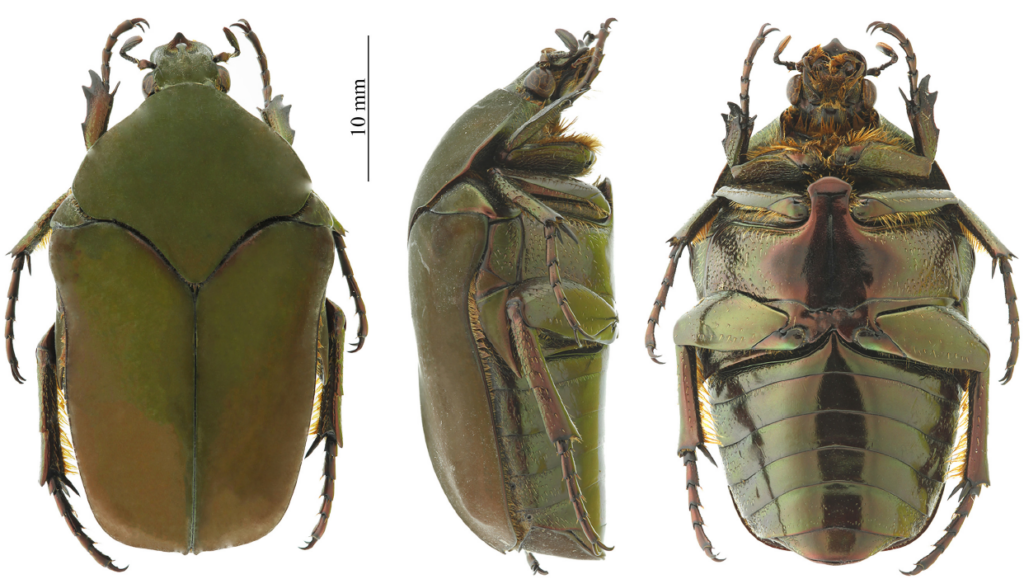
(Adult Cotinis lebasi, dorsal, lateral, and ventral views.)
 English
  Spanish